OutcomesAI
A dense clinical-AI platform, translated into something a healthcare buyer understands in 30 seconds.
- Role
- UI Designer, Pineapple Design Studio
- Timeline
- 3 months, 2025
- Team
- Studio team
- Status
- Live · 2025outcomes.ai
The product, in plain terms.
OutcomesAI is a US-based healthcare platform founded by Kuldeep Singh Rajput, the former CEO of Biofourmis. The core product is Glia, an AI engine that pairs voice agents with licensed nurses to deliver patient care at scale. Glia handles routine interactions on its own: triage calls, scheduling, discharge follow-ups, medication adherence. When the case needs clinical judgment, Glia escalates to a licensed nurse, supported by AI-assisted scribing and decision support that makes each nurse 3–5× more productive.
The business case: healthcare systems face a nursing shortage, sky-high triage costs, and 24/7 patient demand no human team can keep up with. Glia is the answer. The problem when we came on board: the website didn't say any of that.
The brand was hiding the product.
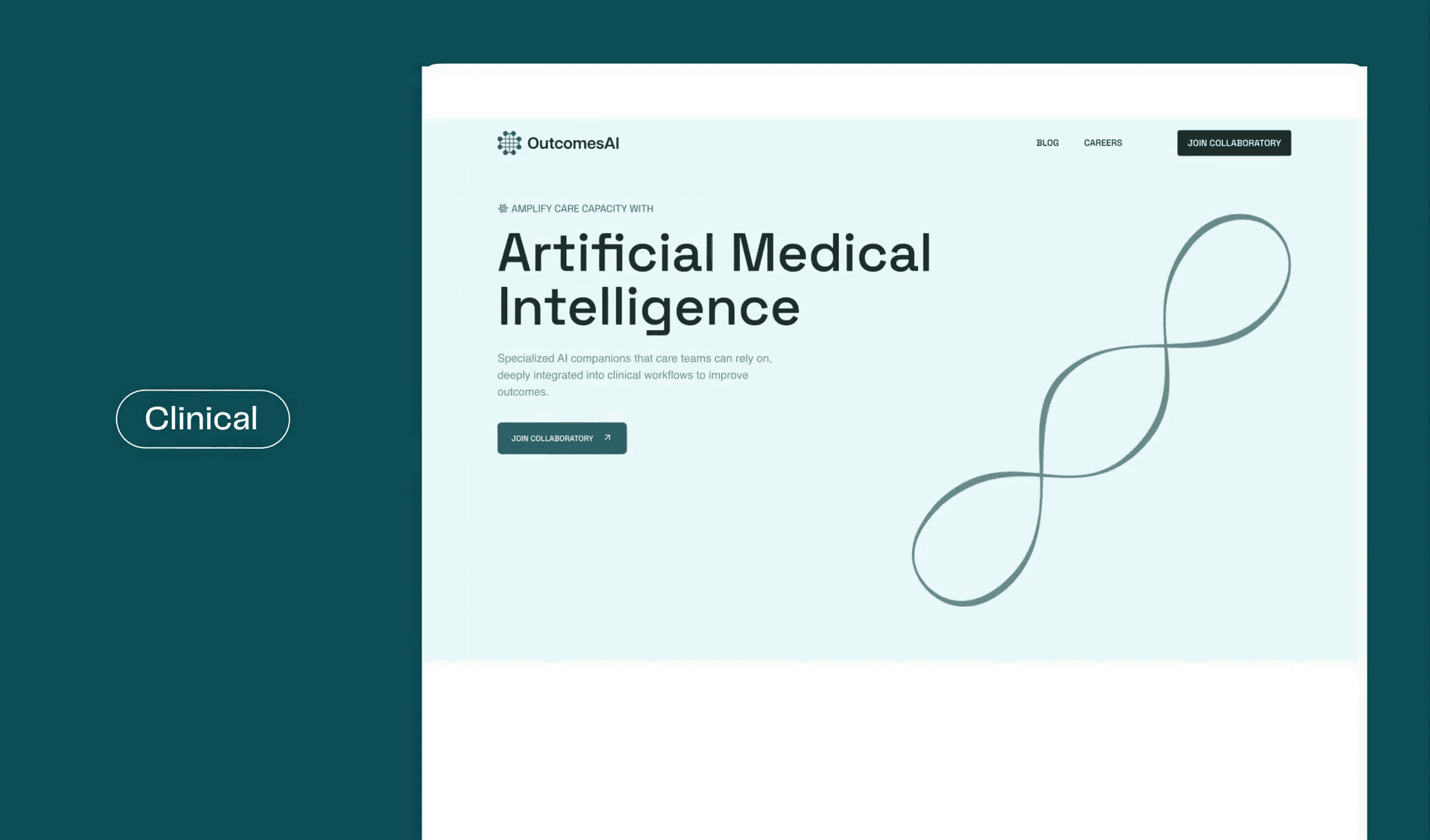
The existing OutcomesAI site had a mismatch: the product was sophisticated, clinically rigorous, and differentiated. The brand told none of that. It read like the rest of the AI health-tech category: abstract claims, dense jargon, no clear explanation of what Glia did or why a healthcare system should trust it with patient calls.
- 01Glia was buriedThe core product had no clear narrative. Visitors couldn't tell what it did, who it was for, or why it was safer than alternatives.
- 02Jargon over clarityThe site relied on text-heavy explanations of multi-agent AI systems. Healthcare buyers don't want to decode technology. They want to see outcomes.
- 03Trust deficitClinical credibility signals (certifications, protocols, nurse testimony) were missing or buried.
- 04Brand felt temporaryThe visual identity was inconsistent and couldn't scale. No messaging system, no pattern language.
The site needed to work as a sales tool for enterprise healthcare buyers, CMOs and COOs who take 6–18 months to evaluate a vendor. If they couldn't understand the product in 30 seconds, they wouldn't schedule a demo.
The category pattern.
Before reframing anything, we audited how other clinical-AI companies were positioning themselves. The pattern was identical across the category: hero metrics, AI-first language, abstract multi-agent diagrams, generic nurse stock photos. None led with the people doing the work.
That gap was the opening. If competitors sold “AI for healthcare,” OutcomesAI could win the buyer in 30 seconds by selling “nurses with their time back.” Same product, opposite shelf.
Nurses first, AI second.
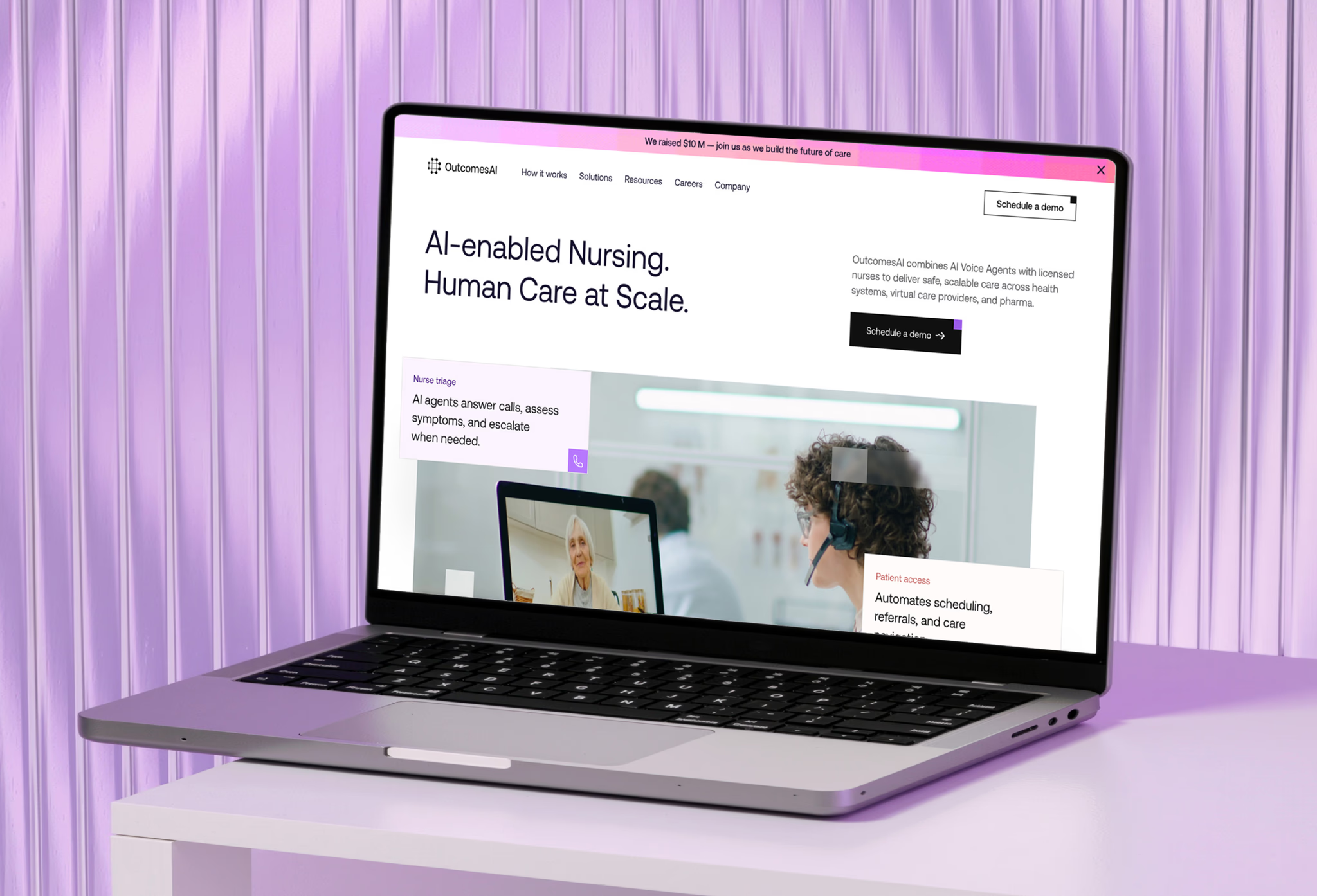
We reframed the narrative. OutcomesAI is a nursing company using AI to give nurses their time back, sold to healthcare. The tagline that shipped, “AI-enabled Nursing. Human Care at Scale,” leads with nurses, and that word order shaped the headlines downstream.
Glia needed its own story.
Glia was the differentiator and it was invisible on the old site. We gave it its own section, a before-and-after workflow narrative, and a scalable pattern system, textured and pixelated, that could represent its presence across surfaces without falling back on generic AI visuals.
Motion as explanation, not decoration.
Complex AI workflows don't survive being written as paragraphs. I used motion to show the Glia sequence: a call comes in, the AI triages, a nurse receives a clinical summary, the interaction closes, all in under ten seconds. The constraint: healthcare buyers read slow animation as precision. Each movement carried weight.
Reframed for the buyer, not the technology.
Each solution leads with the use case: virtual care teams, in-clinic nurses, hospital systems. The underlying capability follows. Buyers stopped having to translate technical features into deployment scenarios; the page does the translation for them.
A system that scales from screen to stage.
Built as a system. The OutcomesAI team could carry it into investor decks, recruiting decks, and conference rigs without coming back to me. The same identity holds up on a phone, in a deck, and on a keynote backdrop.
Same story, on the phone.
Healthcare procurement still happens in email and browser tabs, and a link a CMO forwards has a 50/50 chance of opening on mobile first. The mobile surface had to land the same model in a smaller frame, with no sacrifice to clarity or trust.
Faster comprehension, stronger trust, $10M seed.
The redesign contributed to OutcomesAI's positioning when they raised a $10M seed round led by Sant Ventures in October 2025. The numbers the site needed to make credible: 50% cost reduction in triage operations, 70% of interactions resolved without human escalation, 3–5× nurse productivity with Glia.
The job was translation.
The challenge was making a clinically dense system legible to people making slow, high-stakes decisions. Motion became the main tool: sequence is easier to follow than paragraphs. The bigger lesson: reframing the brand narrative from AI to nursing empowerment shaped the visual hierarchy decisions downstream. Strategy and design were the same thing on this project.