Nexus 247
Balancing mall-style discovery with quick-commerce speed: a unified UI system across multiple brands.
- Role
- UI Designer, Pineapple Design Studio
- Timeline
- 2025
- Team
- Studio team
- Status
- Live · 2025shopnexusone.com
Design a digital commerce experience that balances the speed of quick-commerce with the exploratory nature of mall shopping.
The client needed to stay relevant beyond physical visits: growing engagement frequency, avoiding an occasion-based relationship, and becoming something closer to a daily habit.
Quick-commerce apps are built for transactions. Malls are built for browsing. The brief lived in the tension between the two.
I worked from three principles: familiarity, discovery, speed.
Familiarity: make the experience easy enough to use every day.
Discovery: keep the feeling of browsing a mall, even on a small screen.
Speed: never slow the user down once they know what they want.
A modular, content-driven system: quick-commerce efficiency with in-mall discovery richness.
I built a unified visual system that could scale across multiple retailers, with shared patterns for browsing, merchandising, and checkout. The skin per brand stayed flexible, but the bones of every flow were the same. That kept the experience consistent for the user and the build sane for the team.
Then I added physical-to-digital touchpoints. The mall doesn't end when the user leaves the parking lot, so the campaigns and the loyalty surfaces shouldn't either. Tracking, coupons, and rewards became a thread back into the next visit.
Before opening Figma.
Building quick-commerce for a mall is a hybrid problem, different from standalone quick-commerce. The mall already carries decades of trust, of routine, of a physical place people visit on weekends; the app's job is to bring that mall online without losing the part that makes a mall feel like a mall.
I started by mapping the two patterns I was trying to fuse. Quick-commerce apps, like Blinkit and Instamart, optimise for the transaction: a search bar, a category strip, and a fast checkout. Mall apps optimise for the visit: wayfinding, curated displays, loyalty cards. Neither tries to do both.
The unlock for me was treating the home surface as a wayfinding moment, not a search bar with a horizontal scroll of categories. Each retailer needed space to surface what's new, the same way a window display does in a mall. From there the rest of the flow could stay quick, so the daily-habit feeling held: a scenic home paired with a fast checkout.
I also pulled references outside the category. Editorial homepages from fashion publications, museum wayfinding, even mall directories. The look I was after was closer to a magazine cover than a category grid.
A scalable digital product, now across 17+ malls.
Now live across 17+ malls.
One UI system carries the retailer's identity across brands and categories. No splintered apps, no mismatched flows, no parallel campaigns.
The full flow, end to end.
A walk through the shipped surfaces. Scroll to follow each page in full, and switch between home, browse, and the physical-to-digital checkout.

The phygital handoff, in full.
Bag, coupon, and order tracking. The short path back to the next visit, scrollable in full across each surface.
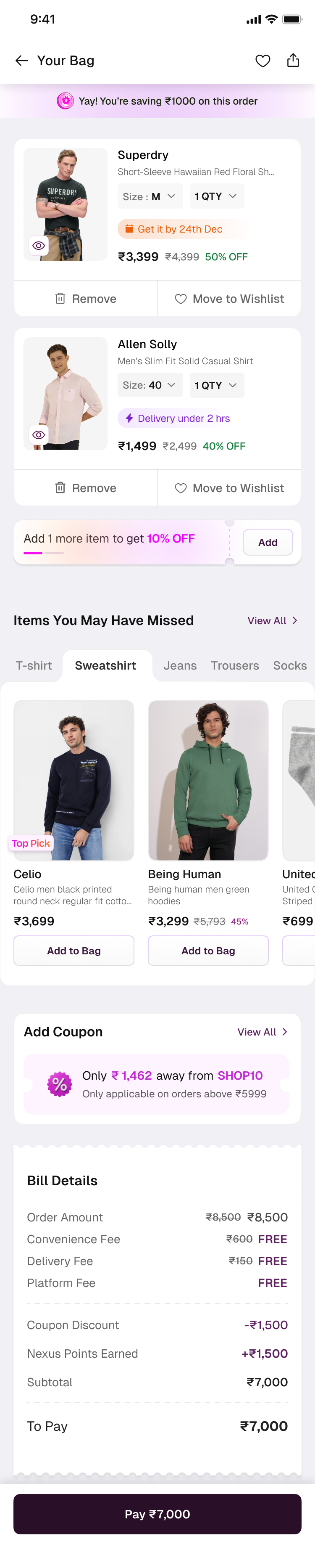
The small surfaces do a lot of the work.
The loyalty card, the coupon, the order confirmation. Short moments that reward a return visit and make the product feel considered.
Digital can extend the physical world without replacing it.
The takeaway for me: designing for the seam between physical and digital is often more valuable than perfecting either side in isolation. Speed, discovery, and brand consistency aren't opposites; they need a system holding them together.
Explorations that didn't ship.
Some ideas didn't land. The throwaways below are loyalty and rewards explorations that didn't ship, kept as a record of where the surface could go, and where it shouldn't.